

 Contact Us

 Other Insurance
A Quick Look at Some Government Health Insurance Schemes

Date: Feb 7, 2022 - Last Modified Dec 22, 2025


India is the world’s largest democracy with a population of 1.4 billion. However, very few people have a comprehensive health insurance policy . The reasons for this coverage gap include lack of awareness and the inability of the many to afford insurance. To cope with this gap, the Government of India has rolled out several schemes to make health care more accessible than ever.
Central Government Health Insurance Schemes
1. Pradhan Mantri Jan Arogya Yojana (PM-JAY) Under Ayushman Bharat
Launched in 2017 by the National Health Policy, PM-JAY is the largest govt. health insurance scheme across the globe that is fully funded by the government. The scheme is meant to provide health care to the bottom 40% of the Indian population, i.e., households under the Socio-Economic Caste Census 2011 (SECC 2011) for rural and urban areas.
- PM-JAY provides Rs. 5 Lakhs cover per family for secondary and tertiary care hospitalization in public and private empanelled hospitals.
- You avail cashless treatment at the point of service, i.e., the hospital.
- Cover includes approximately 1393 procedures covering all treatment costs such as drugs, physician fees, room charges, diagnostic charges, 3 days of pre-hospitalization, 15 days of post-hospitalization, Operation Room, ICU charges, etc.
- The scheme covers all pre-existing conditions from day 1.
2. Universal Health Insurance Scheme
The Universal Health Insurance Scheme is a product of the United India Insurance Company Ltd that increases health care access to families at or below the poverty line.
- This government health insurance scheme covers medical expenses up to Rs. 30,000 upon hospitalization.
- An earning member of the family receives Rs. 50 daily for up to 15 days for being hospitalized.
- Applicants aged 5 to 70 years can avail of this scheme.
- The policy also covers accidental disability and reimbursement of illnesses/diseases.
3. Rashtriya Swasthya Bima Yojana (RSBY)
This scheme is meant to cover labourers working in the unorganized sectors who also happen to constitute about 93% of the nation’s workforce. Backed by the Ministry of Labour and Employment, the RSBY scheme provides health care to Below Poverty Line (BPL) families.
- The RSBY scheme covers up to 5 members, including the unorganised sector worker.
- The sum insured given would be Rs. 30,000 per family per year on a family floater basis.
- Cashless covers enable expedited claims against hospital expenses and common illnesses, including transportation costs with Rs. 100 limit per visit and the overall limit of Rs. 1000.
- All pre-existing diseases are covered under this scheme from day 1.
4. Aam Aadmi Bima Yojana (AABY)
The Aam Aadmi Bima Yojana (AABY) provides health care to individuals of select professions such as carpentry, fishing, handloom weaving, salt-production, sericulture, and other select vocations.
- AABY scheme offers Rs. 30,000 as a basic cover and half the amount is subsidized by the Social Security Fund.
- Applicants aged 18 to 59 can apply for this scheme.
- The AABY government health insurance scheme applies to only one family member who must also be either the head or the earning member of the family.
- Coverage includes accidental death, disability, death due to natural causes, and sometimes even scholarship benefits.
5. Employee’s State Insurance Scheme
The Employee State Insurance Scheme is applicable to an individual employed in a non-seasonal factory that consists of more than 10 employees, as described under section 2 (12) of the Employee State Insurance Act, 1948.
- The scheme covers individuals working in hotels, shops, cinemas, restaurants, road-motor transport undertakings, and the wage limit of the employee is set to Rs. 21,000 per month.
- Covers include medical expenses, disability as well as the death benefit.
- Women employees enjoy maternity benefits such as 100% daily wages for 26 weeks from the time the woman goes into labour and 6 weeks in case of a miscarriage.
- Employees receive a cash allowance for 24 months if the employee is unable to work due to injury or involuntary unemployment.
6. Pradhan Mantri Suraksha Bima Yojana (PMSBY)
The PMSBY scheme is offered by public sector general insurance companies or, sometimes, by privatized institutions like banks. With an annual premium as low as Rs. 12, the scheme is extended to cover personal high-risk accidents.
- The scheme is available to individuals holding a bank account who fall in the age range of 18 to 70 years.
- The nominee receives Rs. 2 lakhs if the primary applicant of the scheme is fully disabled or dies in an accident.
- Partial disability is covered at Rs. 1 lakh.
- Applicants are eligible to can claim tax deduction under Section 80C of the Income Tax Act, 1961.
7. Central Government Health Scheme (CGHS)
The Central Government offers CGHS to the Central Government employees and pensioners. The scheme spread across 71 cities, covering beneficiaries undertaking allopathy, homeopathy, or any Indian medicine treatment.
- Widows or children of ex-Central Government employees eligible under family pension can avail CGHS.
- Few out of many facilities include outpatient department treatments, diagnostic tests, or medical consultations.
- You can also get reimbursement of expenses for emergency treatments or purchasing hearing aids, artificial limbs, etc.
- The CGHS scheme extends to family welfare as well as maternity and child health services.
8. Janshree Bima Yojana (JBY)
Launched collectively by the Central Government and the Life Insurance Corporation (LIC), JBY provides life insurance to rural and urban marginalized individuals working in any of the 45 occupational groups approved by LIC and the Nodal Agency.
- The premium to be paid is Rs.200 per member, wherein the State Government/Nodal Agency pays 50%, and Social Security Fund pays the remaining 50%.
- Women under Self-Help Groups (SHG) can avail of term insurance with Rs. 30,000 coverage.
- The Shiksha Sahyog Yojana (SSY) covers children whose parents are covered under JBY. Up to 2 children get a scholarship of Rs. 600 each paid every 6 months, conditions apply.
- On demise or total permanent disability due to an accident of the applicant, nominees receive Rs. 75,000 as compensation.
State Government Health Insurance Schemes
1. Mahatma Jyotiba Phule Jan Arogya Yojana
This scheme by the Maharashtra Government offers medical insurance to individuals below the poverty line. Applicants can claim up to Rs. 1.5 lakhs against diseases from the first day of the policy.
2. Employees and Journalists Health Scheme, Telangana
Offered by the Telangana Government, this scheme provides medical coverage to the state government’s employees and journalists with coverage extended to retired employees as well.
Conclusion
The aforementioned schemes for health insurance by Indian Government ensure that citizens of the country do not face financial difficulties in times of ill health. health insurance plans can help reduce the burden of expensive medical treatments. This way, one can focus on recovery and not worry about the cost.
This blog is intended solely for educational and informational purposes. Content reflects data at time of publication and may not accurately reflect current premiums, terms, or regulations. Readers are encouraged to confirm the accuracy and relevance of the data before making any significant decisions. SBI General Insurance disclaims responsibility for any errors or consequences arising from the use of outdated information provided herein. For more details, please refer to the policy wordings and prospectus before concluding the sales. *Add-ons are subject to payment of additional premium.
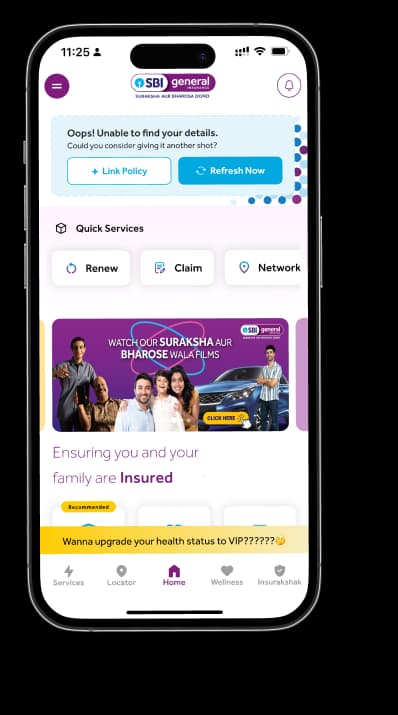
Access and manage all your Insurance Needs in one place, right at your Fingertips.


4/5*
Access and manage all your Insurance Needs in one place, right at your Fingertips.


Vision
Our vision is to become the most trusted general insurer for a transforming India.
Mission
Our mission is to provide simple and innovative general insurance solutions, be responsive to our customers' needs and build a sustainable business for the future.
We're socially active!