


 Contact Us


 Other Insurance
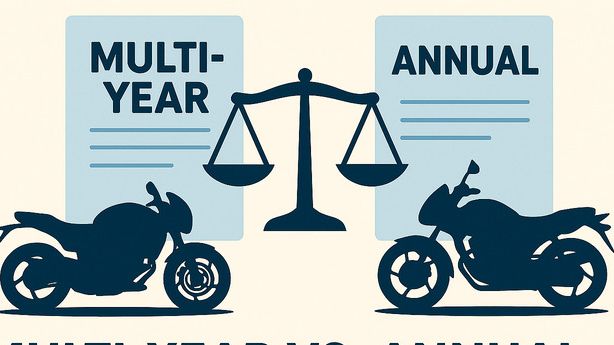
Multi-Year vs Annual Bike Insurance – Which is Better?
Date: May 4, 2026 - Last Modified May 4, 2026


Multi-year bike insurance provides coverage for 2 to 5 years with a one-time premium, while annual bike insurance offers one-year coverage that requires yearly renewal. The choice depends on budget, flexibility, and long-term convenience.
Riding without a valid bike insurance policy is a punishable offence under Section 196 of the Motor Vehicles Act, 1988 (as amended from time to time). Failure to follow these rules can result in penalties. Expired or unrenewed coverage carries the same legal consequences.
Continuous protection remains mandatory by law. Selecting the right tenure, annual or multi-year, determines how consistently protection remains active and legally valid.
What Is Annual Bike Insurance?
Annual bike insurance is a two-wheeler insurance policy providing coverage for 12 months. It requires renewal before expiry to maintain uninterrupted protection and covers mandatory third-party liability. Under a comprehensive plan, it also covers own-damage to the vehicle and allows riders to revisit their coverage every renewal cycle.
Coverage Duration and Renewal
| Feature | Details |
| Policy Duration | 1 year for all: Third-Party, Comprehensive, or Standalone Own Damage |
| Renewal Deadline | Must be completed before the policy expiry date |
| NCB Retention | Benefit is forfeited if not renewed within 90 days of expiration |
| Recommended Time | Renew at least 30 days before the due date |
| Post-Expiry | Physical inspection and document verification are required for reinstatement |
Key Features of Annual Policies
- Covers a fixed period of 12 months from the date of issuance.
- Offers third-party liability and own-damage coverage under comprehensive plans.
- Allows riders to adjust add-ons or change insurers at renewal.
- No Claim Bonus (NCB) starts at 20%.
Insured Declared Value (IDV) is recalculated at each renewal to reflect depreciation.
What Is Multi-Year Bike Insurance?
Multi-year bike insurance provides coverage for two to three years under a single policy document. This long-term two-wheeler insurance policy reduces the need for annual renewals. It delivers consistent protection throughout the chosen tenure. The policy is available as a comprehensive plan or as a standalone third-party insurance cover.
Coverage Duration
Multi-year policies provide coverage for an extended period, reducing renewal frequency. This is driven by the regulatory requirement for new two-wheelers to maintain a five-year third-party liability cover. While standalone own-damage covers remain annual, comprehensive multi-year plans for two to three years offer a balanced long-term solution.
| Policy Type | Available Duration |
| Third-Party Liability Only | Up to 5 years |
| Comprehensive | 2 to 3 years |
| Standalone Own Damage | Annual only |
IRDAI Rules for Long-Term Policies
The Insurance Regulatory and Development Authority of India (IRDAI) has issued the following guidelines governing long-term two-wheeler insurance policies:
- New two-wheelers registered from 1st September 2018 must carry a five-year third-party liability policy, as directed by the Hon’ble Supreme Court of India.
- Standalone long-term own-damage covers are not permitted; only annual standalone own-damage policies are currently available.
- Insurers may offer comprehensive multi-year package policies for terms of up to three years.
Third-party premium rates are determined and revised periodically by IRDAI, independent of the policy term.
Difference Between Multi-Year and Annual Bike Insurance
The difference between multi-year and annual bike insurance is mainly regarding premium structures and renewal obligations beyond policy duration. It also involves No Claim Bonus (NCB) accrual and coverage continuity.
| Parameter | Annual Bike Insurance | Multi-Year Bike Insurance |
| Policy Term | 1 year | 2 to 3 years |
| Renewal | Required every year | Once per policy term |
| Premium | Recalculated at each renewal | Fixed own-damage component at inception |
| Risk of Lapse | Higher if renewal is missed | Lower due to extended coverage |
| IDV | Recalculated | Set at the time of policy inception |
Both formats provide coverage for mandatory third-party liability. The choice rests on ownership plans and renewal discipline.
Key Takeaways
- Annual policies suit riders seeking year-on-year flexibility for add-ons.
- Multi-year policies reduce lapse risk and fix the own-damage premium at inception.
Both formats are regulated by IRDAI and ensure legal compliance.
Advantages of Multi-Year and Annual Bike Insurance
Multi-Year Bike Insurance
- Eliminates the need for annual renewals with a single document, reducing the risk of unintended coverage lapse
- May provide a tenure reduction on the own-damage premium
- Locks in the premium for the entire duration.
Annual Bike Insurance
- Provides the flexibility to revise coverage, add-ons, and change insurers at each renewal
- Allows the Insured Declared Value (IDV) to be updated annually to reflect the current market value
- Suited for riders who may sell, transfer, or replace their vehicle within a short period
- Enables clear year-on-year No Claim Bonus (NCB) tracking.
Key Takeaways
- Multi-year plans lock in the premiums.
- Annual plans allow for annual updates to the Insured Declared Value.
- Long-term policies may offer specific tenure reductions on the own-damage premium component.
Factors to Consider Before Choosing the Right Policy
Before deciding between annual and multi-year bike insurance, riders should evaluate the following:
- Ownership duration: Riders planning to retain their two-wheeler for more than two years are likely to benefit from a multi-year policy format.
- Premium outlay: Multi-year policies require a higher upfront payment, while annual plans allow for smaller premium amounts paid year-on-year.
- NCB status: Riders with an active No Claim Bonus may prefer annual renewal to track and apply NCB clearly at each renewal point.
- Add-on requirements: Coverage needs may evolve over time; annual policies allow for greater flexibility to adjust add-ons* at every renewal.
Renewal reliability: Riders who might have a habit of overlooking renewal deadlines can benefit from the uninterrupted coverage offered by a multi-year policy.
Conclusion
Both annual and multi-year bike insurance serve distinct requirements. Annual policies offer flexibility to adjust coverage year on year. Multi-year policies provide long-term continuity with reduced administrative obligations. Riders can buy bike insurance online by comparing tenures and add-on* options. The right choice is shaped by ownership duration, budget, and individual priorities.
FAQs
1. Is multi-year bike insurance mandatory in India?
Multi-year third-party liability cover for five years is mandatory for all new two-wheelers registered from 1st September 2018. This follows IRDAI directives and the Hon'ble Supreme Court of India's order. Comprehensive or own-damage multi-year coverage remains optional for policyholders.
2. Which bike insurance is better for short-term ownership?
Annual bike insurance is more suitable for short-term ownership. It provides the flexibility to discontinue or modify coverage at the end of each year. This avoids a long-term commitment tied to a specific policy term.
3. Does NCB differ in multi-year and annual policies?
No Claim Bonus (NCB) accrues in both policy types during claim-free periods. In annual policies, NCB is applied at each renewal. In multi-year policies, it accumulates throughout the term and is applied at renewal.
*Add-ons are subject to payment of additional premium.
This blog is intended solely for educational and informational purposes. Content reflects data at time of publication and may not accurately reflect current premiums, terms, or regulations. Readers are encouraged to confirm the accuracy and relevance of the data before making any significant decisions. SBI General Insurance disclaims responsibility for any errors or consequences arising from the use of outdated information provided herein. For more details, please refer to the policy wordings and prospectus before concluding the sales. *Add-ons are subject to payment of additional premium.
Access and manage all your Insurance Needs in one place, right at your Fingertips.



4/5*
Access and manage all your Insurance Needs in one place, right at your Fingertips.


Vision
Our vision is to become the most trusted general insurer for a transforming India.
Mission
Our mission is to provide simple and innovative general insurance solutions, be responsive to our customers' needs and build a sustainable business for the future.
We're socially active!