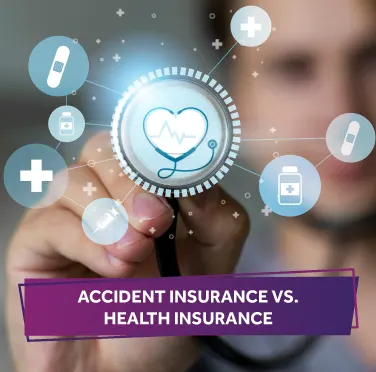
Accident Insurance Vs. Health Insurance
blog
Jun 4, 2024
expertexpertexpert

In today's growing expenses and uncertainty, it has almost become mandatory for everybody to have insurance in place, whether it is health insurance, vehicle insurance, accident insurance, or travel insurance. These insurances can protect you from financial burdens in unforeseen situations arising. Health insurance and accident insurance are two types which typically cover medical expenses in the event of accidents and illnesses; however, there is a difference between accident insurance and health insurance. Confused? So, let's clear your doubts and explore accident insurance vs. health insurance and more.

What is Health Insurance?

As the name implies, health insurance provides coverage for the insured individual's overall health. This insurance provides coverage for any uncertainties that may arise as a result of certain medical conditions, injuries, or illnesses. Although some diseases or conditions may not be covered by some health insurance plans due to their nature, a good health insurance provider typically covers the majority of illnesses and diseases. The diseases not covered in your insurance plan will be listed in the exclusion list of your policy document. Furthermore, health insurance policies cover more than just hospitalisation costs; they also cover ambulance fees, diagnostic costs, pre- and post-hospitalisation expenses, and more.

At the time of health insurance purchase, the health insurance provider reviews all of your medical information and history to determine the potential risk associated. That's how your premium is determined.

Additionally, several reputed health insurance providers offer additional benefits, such as coverage for your spouse and children. This is an excellent feature since it helps you put your best foot forward and take the required precautions to avoid a medical emergency.

What is Accident Insurance?

Personal accident insurance, like health insurance, provides coverage for medical and hospital expenditures, but only in the event of an accident and covers these expenses only. In simple terms, if you or your insured loved one sustains an accidental injury, your personal accident coverage will cover the medical expenses. In the event of a sudden death in an accident, the person nominated will be compensated up to the sum insured. Personal accident coverage provides a fixed amount that can be used for both medical and non-medical costs. In the event of a whole or partial disability as a result of an accident, the payment might cover your income loss while you recover.

The goal of personal accident coverage is to provide help in the event of an accident rather than completely replace conventional health insurance coverage. Personal accident coverage can be obtained as a separate policy.

Difference Between Personal Accident Insurance vs. Health Insurance

Parameter

Accident Insurance

Health Insurance

The Purpose 
 

Personal accident insurance is designed to provide policyholders with insurance coverage only when hospitalisation, accidental death, or either partial or severe disabilities occur as a result of an accident.

The purpose of health insurance is to cover the costs of hospitalisation, medical treatment, and other expenses incurred as a result of an injury or illness.


Scope


The scope is limited and focused on injuries and accidents.

Comprehensive coverage for a wide range of healthcare requirements, including preventative care, diseases and illnesses, and accidents.

Disability Coverage 


Accident-related damage is frequently unpredictable and might result in disabilities. Accident insurance provides coverage in practically every situation resulting in disability.

It does not provide disability coverage, particularly when it is the result of an accident.


Death Coverage 

It provides coverage even after the person's death as a result of an accident. The sum covered goes to the nominee selected by the policyholder when purchasing the policy.

No health insurance provides coverage for death.

Pre-and post-hospitalisation coverage


It covers hospitalisation costs associated with the treatment of injuries sustained as a result of an accident.


It covers pre-hospitalisation expenditures, which are expenses incurred before the patient's hospitalisation, as well as post-hospitalisation expenses incurred after the patient is discharged from the hospital due to illness or injury.

Tax Benefits

Not applicable

Can claim tax benefit

Add-ons

Cannot purchase add-ons

Can purchase add-ons

Medical Coverage 


It can be comprehensive, but personal accident insurance coverage provides a lump sum value after an accident that can be used for hospitalisation. 
 

It provides a variety of benefits when it comes to expenses associated with illness, hospitalisation, ambulance charges, day-care fees, and any surgical procedures that are covered in your plan. You will need to buy comprehensive health insurance that includes all of the benefits and add-ons to your coverage.

Pre-existing conditions

Not covered

Health insurance policies cover a variety of medical conditions that you may be suffering from in their coverage after a certain waiting period.

Maternity cover

Not applicable

Many health insurance cover maternity benefits after the waiting period.


Invest in Insurance for a Secure Tomorrow

Both health insurance and accident insurance offer financial support during a medical emergency. Because any medical emergency, whether a health condition or an accident, is unpredictable; one does not need to use saved funds or take out loans to cover hospital fees if they purchase health insurance in advance. Adding personal accident coverage to a basic health insurance policy broadens your protection by covering the full cost of medical care for accidental damage.

FAQS about Accident Insurance vs. Health Insurance
Is an accident insured by health insurance?

No, personal accident insurance must be purchased separately or as an add-on to health insurance. Although health insurance covers the cost of hospitalisation.

What is the main difference between accident insurance vs. health insurance?

A health insurance plan covers a variety of medical emergencies. Accident insurance coverage is an add-on to a health or auto insurance policy.

Can I purchase health insurance and personal accident coverage for myself from a single company?

Yes, provided it is available through your insurance company.

Which insurance is better: health insurance or personal accident insurance?

Health insurance offers broader coverage when compared with personal accident insurance. This means that health insurance covers a broader spectrum of claimable events than personal accident insurance, which solely covers accidental injuries.

What are the benefits of personal accident insurance?

Accident insurance provides financial support in the event of an accidental disability, injury, or death.

Is it a wise decision to get health insurance online?

Yes, purchasing a health insurance plan online is an excellent choice because it allows you to save time, complete the purchase anywhere having an active internet connection, and most likely receive the policy online.

Disclaimer: The above information is indicative in nature. For more details on the risk factor, terms and conditions, please refer to the Sales Brochure and Policy Wordings carefully before concluding a sale.

Recent Blogs

General Insurance

Benefits of Insurance

The importance of insurance in our lives can never be exaggerated. It is one of the best risk mitigation investments that you can make to ensure that your loved ones are taken care of in your permanent absence. Different insurance products are available for different requirements. Life, health, home, car, marine are some examples of different insurance products. Choose your policy based on your needs and requirements. The policy you select should not only serve you but also make a difference to your family. Let us take a closer look at the benefits of insurance. Death benefits Life insurance will protect the family from financial hardship in case of an unfortunate death of the policyholder. The insurance company will pay the sum assured in the contract, in addition to the bonus which is known as a death benefit. The family may never be able to fill the void created by the tragedy, but this financial support can make a huge difference. 2. Grow your investment In some policies, you enjoy dual benefits --protection and investment. A part of your premium will go towards insurance and the balance will be invested in equity, debt, or a combination of both. This is one of the unique advantages of insurance. Hence, when you buy insurance, you can get coverage as well as generate returns on the investment. Some policies even allow you to switch between funds as your goals change. Maturity benefits If you make no claim and have paid the premium regularly, then the total premium paid will be returned to you at the time of maturity. This way, you can save while enjoying a protective cover. Tax benefits One of the top benefits of insurance in India is the tax benefit it offers. As per the Income Tax Act, you can get a tax deduction when you purchase insurance. You can reduce the tax liability by buying life insurance and medical insurance. The premium paid towards the life insurance policy is eligible for a deduction under Section 80C up to an amount of Rs. 1.5 lakh. Additionally, the payout you receive will also be tax-free. In the case of health insurance, you get a deduction under Section 80D. If you are paying a premium for your partner and senior citizen parents, you can get an additional deduction. Meeting liabilities There are times when you need financial support and insurance will do just that. In case of a medical emergency, your entire savings could be drained and this is when the insurance policy will make a lot of difference. Such liabilities may continue to arise in our lives and dealing with them without steady income could be troublesome. In case of the unfortunate demise of the policyholder, the family may find itself neck-deep in debts and loans. Taking a life insurance policy can ensure that the family continues to have the same lifestyle even if the earning member passes away. That your loved ones will remain safe and settled is a nice feeling. Riders A lot of insurance companies offer riders to enhance the coverage. The riders are available for all types of insurance products and you can choose them according to your needs. You can enjoy an additional cover by paying a small premium. Meet your long-term goals All of us have set goals of travel, retirement, education and marriage of children, etc. But we cannot plan how our life goes. One medical emergency can upset every movement in our lives. Loss of an earning member will be a huge blow. Whether you are planning for yourself or your loved ones, insurance will ensure that you achieve long-term goals. Unexpected events or contingencies will not put an end to your goals and you will have the necessary financial assistance to turn your dreams into a reality. Whether it is a medical emergency, car accident, or any other loss, if you have an insurance cover, the insurer will compensate for the same. Do not delay the purchase of insurance which is an absolute must in today’s times. Disclaimer: The above information is indicative in nature. For more details on the risk factor, terms and conditions, please refer to the Sales Brochure and Policy Wordings carefully before concluding a sale.

General Insurance

Benefits of Online Insurance

We are all living in the digital age and how! You can find everything online, whether it’s your groceries, your outfit of the day, or even your life partner. In the financial industry as well, everything from banking to investments have gone digital. So has insurance. Every leading insurance provider in the country today is serving its new and prospective customers online. Not just that, there are many online insurance aggregators operating in the market offering all the available information on different policies and plans of different insurers on a single platform. No wonder, there has been a paradigm shift from the traditional method of depending on insurance agents to taking the digital route to buy insurance. The fact that there are many benefits of buying insurance online has also added momentum to this shift. Let's look at some of the benefits of online insurance over traditional insurance. What are the benefits of buying insurance online? Convenience: Buying insurance online is a lot more convenient as it can be done any time any day from any corner of the world with just a click of the button. You don't need to visit any office or arrange any meeting. When buying insurance online, you are saving time, energy and money that you would have otherwise spent on travelling from one place to another meeting different insurers. Instant policy: One of the biggest benefits of buying insurance online is that you can be issued a policy instantly if all the paperwork is in place. Compared with the offline insurance purchase, which may involve multiple meetings with insurers/agents for sharing forms, discussing various plans and submission of final documents, etc., the entire process of online insurance involving the same steps can be completed within a span of a few minutes. Lower Premiums: When buying insurance online, the customer buys directly from the insurer, thereby leaving no space for distributor's margin or commissions. Also, the overhead costs of maintaining an online platform are much lower than that involved in offline infrastructure. These cost-savings translate into lower premiums for online customers. Easy comparison of different products: Online insurance portals make it extremely easy for customers to compare different types of plans and policies. For instance, if you are planning to buy a health plan, you can simply visit the official website of your chosen insurer and check all the different policies it offers along with their specific benefits and premium quotes in order to make a well-informed decision. You can also compare health policies of different insurers through online insurance aggregators to choose the best health plan for yourself. This kind of comparison, if had to be done offline, could have taken days if not weeks. Choosing add-ons: Buying insurance online makes it easy to choose relevant add-ons with your policy. Add-ons offer additional protection and benefits to policyholders by paying a little extra premium. When purchasing any kind of policy online, customers can always check the option to add any of the add-on covers offered by the insurer along with the price at which they are offered. After making a quick assessment of whether an add-on can prove to be useful and worth the money or not, it can be chosen to be added to the main policy. Avoids mis-selling: The offline method of buying insurance lacked transparency as prospective customers were dependent on a handful of people for all the relevant information. Rather than making a choice themselves, they were relying on a third person to decide on what's the policy best suited for them. This often led to mis-selling of insurance products. But that's not a concern in the case of online insurance. When purchasing a policy online, customers can check all the features, benefits and premium prices of different plans before finalising the product they want to buy, leaving no scope of mis-selling. Reviews: One of the benefits of online insurance is that customers can read reviews of different products and insurers before making their final decision. This kind of first-hand feedback is not available when you are buying insurance through the traditional route. Reading reviews and comments can give the kind of information you will not get on any other platform and help you make the right choice. It is due to these advantages that the online insurance sector is growing in India at an enormous scale and is becoming the preferred route for customers to buy life, health, motor and other kinds of insurance policies. Disclaimer: The above information is indicative in nature. For more details on the risk factor, terms and conditions, please refer to the Sales Brochure and Policy Wordings carefully before concluding a sale.

General Insurance

How Much Does a COVID Test Cost in India?

With newer variants emerging constantly, the COVID–19 virus seems to be spreading more quickly than before. While looking out for symptoms and self–isolating can help you recover and prevent further spreading of the virus, getting a COVID test helps you confirm your diagnosis. It is especially useful as an official document, whether for treatment or to receive benefits. This article will help you figure out the cost of taking a COVID test in India. What is the COVID test cost in India? The cost of getting a COVID test done across various Indian states is as follows: Delhi: The Delhi Government has reduced the cost of RT–PCR tests in private labs to Rs 800. Plus, the cost of home collection samples has been reduced to Rs 1200 from Rs 2400. Maharashtra: The Maharashtra Government has also slashed the prices of RT–PCT tests. The new prices are Rs 500 to submit a swab at the collection centre, Rs 600 at quarantine centres, and Rs 800 at the testing centres. Uttar Pradesh: According to a notification issued by the Health and Family Welfare Additional Chief Secretary of Uttar Pradesh, the cost of RT–PCR has been decided at Rs 700 in private hospitals. However, the price of RT–PCR tests at private labs with home sample collection can go up to Rs 900. Rajasthan: An RT–PCR test in Rajasthan costs Rs 500 to Rs 1000. Seeing the wide range, the prices will soon have to be rectified to a more stable alternative. Haryana: Costs of RT–PCR in Haryana have been reduced to Rs 1200. Kerala: The Kerala Government has also reduced RT–PCR prices from Rs 1700 to Rs 500. Additionally, approved labs accredited by the state and Indian Council of Medical Research (ICMR) have to conduct the test at the new prices. In contrast, government hospitals are doing so for free. Andhra Pradesh: Due to the increased availability of testing kits, the government has slashed the prices of RT–PCR tests by 40%–50%. Tests in government labs will be charged at Rs 475, whereas the National Accreditation Board for Testing and Calibration Laboratories (NABL) will charge Rs 499. Karnataka: The government has fixed the price of testing for COVID–19 at Rs 800 at government labs and Rs 1200 at private labs. Further, home collection prices can go up to Rs 1600. Gujarat: In Gujarat, the cost of RT–PCR was reduced from Rs 1100 to Rs 900 if you opt for home collection and have the sample tested at a private lab. If you directly give your sample at the lab, you will be charged Rs 700. West Bengal: The West Bengal government has also cut down the price of COVID–19 tests in private centres from Rs 2250 to Rs 1500. Note: Keep in mind that these prices are for reference and are subject to change as per the directives issued by the respective State Governments. Now that you know more about the COVID–19 test cost in India, get yourself tested if required. Remember to buy health insurance for yourself and your loved ones to stay prepared for times of illness. Disclaimer: The above information is indicative in nature. For more details on the risk factor, terms and conditions, please refer to the Sales Brochure and Policy Wordings carefully before concluding a sale.

General Insurance

Difference Between Insurance and Assurance

In India, a lot of people tend to depend on a middleman, like an agent, to help them buy their insurance policies. Not to overwhelm you, but this probably could be because of the insurance documentation having a lot of jargon, isn't it? If you are somebody who is learning the basic terminology of insurance and wondering what assurance and insurance difference is, you have come to the right page. This page explores the common terms 'insurance and assurance' meanings, assurance versus insurance, and more. So, keep reading!