


 Contact Us


 Other Insurance
Complete Guide on Vehicle Fitness Certificate
Date: Apr 6, 2026 - Last Modified Oct 5, 2026


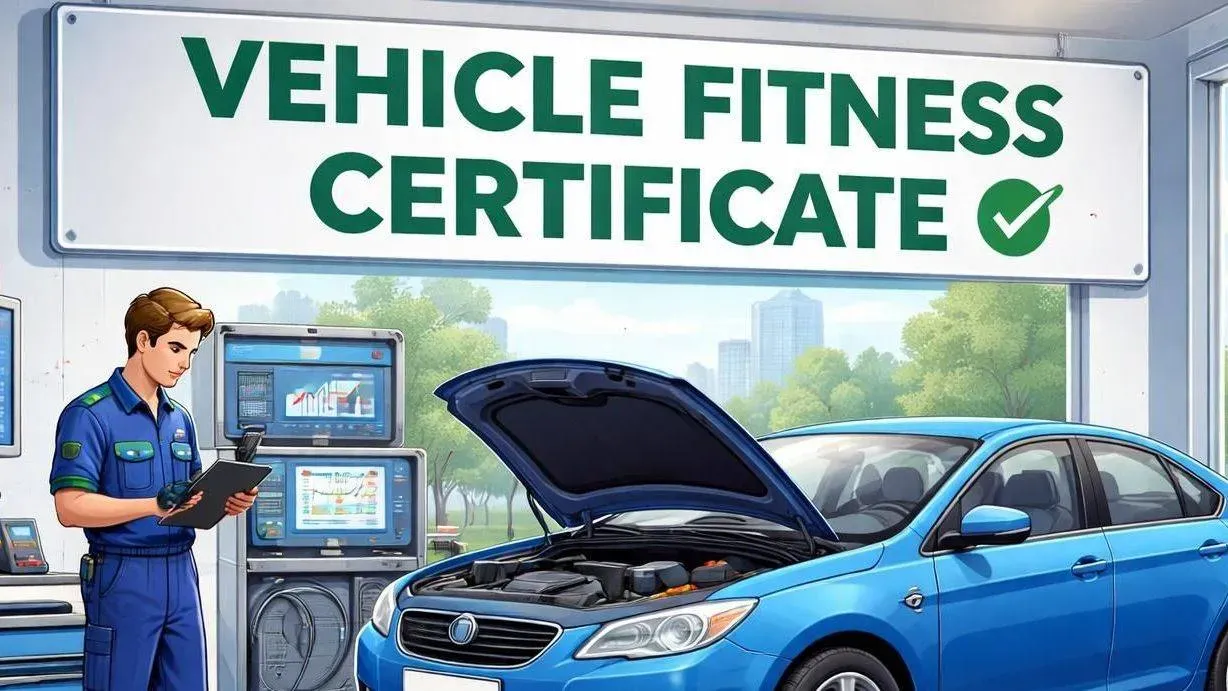
Safety is paramount while on the roads. One essential aspect ensuring this is a vehicle fitness certificate. It is a mandatory requirement under the Motor Vehicles Act 1988 to confirm that your vehicle meets the safe operation standards. It’s a document to comply with the legal regulations while attaining peace of mind for you and your loved ones’ safety. Find the breakdown of how the vehicle certificate works, the process to obtain it, and things to expect.
What is a Vehicle Fitness Certificate?
A vehicle fitness certificate is a legal document that the Regional Transport Office (RTO) issues to confirm that your vehicle is roadworthy. The certificate indicates that the vehicle meets the safety and emission standards per the government regulations.
The RTO conducts a comprehensive inspection of the brakes, lights, speedometer, exhaust emissions, and overall structural integrity of the vehicle to confirm its fitness for the road.
Purpose and Importance of a Fitness Certificate
A vehicle fitness certificate meets standards that present you as a responsible driver. It supports you in the following key areas:
Confirms Vehicle’s Roadworthiness
Since the essential components contributing to the vehicle’s performance are thoroughly inspected before issuing the vehicle fitness certificate, it is fit for varied road conditions.
Ensures Road Safety
The inspection process checks if the vehicle meets key safety standards in terms of brakes, lights, steering, and more.
Part of Legal Compliance
A bike or a car fitness certificate adheres to the regulations of the Motor Vehicles Act. It is one of the crucial steps to stay compliant, along with maintaining other crucial vehicle documents.
An Insurance Requirement
A valid vehicle fitness certificate is essential to renew an insurance policy and register an insurance claim successfully, as it includes the details of your vehicle’s condition.
Denotes Controlled Emissions
Along with safety standards, emission release is also part of the inspection for a car or bike fitness certificate. As a result, you contribute to a lower environmental impact.
Who Needs a Vehicle Fitness Certificate in India?
All commercial vehicle owners and owners of private vehicles older than 15 years require a vehicle fitness certificate.
Commercial Vehicles
The vehicle fitness certificate for commercial vehicles like trucks, buses, taxis, vans, and goods carriers is required from the day of registration.
Private Vehicles
The RTO issues the car fitness certificate for private owners during the vehicle registration. The same applies to a bike fitness certificate.
Vehicle Fitness Certificate Validity & Fees
The validity of a personal certificate for different types of vehicles is explained as follows:
For personal vehicles like cars and bikes, the validity of the vehicle fitness certificate is 15 years from the date of registration. After the validity ends, you must renew the certificate.
Commercial vehicles like buses, vans, and trucks come with a vehicle fitness certificate valid for two years from the day of registration. The vehicle owner is required to renew it annually once the vehicle is older than 8 years.
Fees for obtaining a vehicle fitness certificate differ across states based on the type of vehicle and its age.
Step-by-Step Process to Get a Vehicle Fitness Certificate
You can either apply for a vehicle fitness certificate online or complete the process offline. Steps to follow for both approaches are outlined as follows:
Online process
Search for the Parivahan Sewa portal: https://parivahan.gov.in/.
Click on the ‘vehicle-related services’ option under the ‘online services’ menu.
Select your state, enter the vehicle registration number, and select the authorised RTO.
Click on the ‘apply for fitness certificate’ option on the next page.
Provide details like your vehicle’s registration number, the last 5 digits of the chassis number, and your mobile number. Verify the same with an OTP.
Review the relevant information about your vehicle and enter your car or bike insurance details.
Pay the fee for the vehicle fitness certificate as stated at the end through any of the online payment gateways you like.
Upon successful payment, you shall receive a confirmation message along with the prompt to print the application letter.
Take the completed form along with the fee payment receipt to the RTO office and get your vehicle inspected.
Once your vehicle passes the inspection parameters, you shall receive the fitness certificate digitally.
Offline process
As an alternative to filling out the form online, you can request it at the RTO office in your district. The next steps in obtaining a vehicle fitness certificate offline include:
Fill in the form with the relevant vehicle details.
Submit the necessary vehicle documents that confirm your vehicle’s registration, tax compliance, emission levels, and more.
Pay the applicable fee as per your state laws and vehicle specifications.
Submit your vehicle for a physical inspection on the scheduled date.
Once it meets the inspection standards, the fitness certificate is issued to your registered address.
Guide on Vehicle Fitness Certificate Renewal
You can renew the vehicle fitness certificate through a similar process. It involves the following steps:
Log in to the Parivahan portal, click on the ‘vahan service’ option.
Select the ‘renewal of fitness certificate’ option under the ‘online services’ menu.
Enter your registration number, chassis number, and confirm details through the OTP sent to your contact number.
Select the ‘fitness inspection + certificate’ option under the ‘service details’ section.
Fill in the required bike or car insurance details and press the ‘submit’ button.
Upload relevant documents for renewal by clicking on the ‘DMS’ option.
Book your appointment for the vehicle inspection and pay the renewal fee.
Visit the RTO in your district with the filled-in form along with the fee payment receipt on the scheduled vehicle inspection date.
The renewal request is processed once your vehicle passes the inspection.
Documents Required for a Vehicle Fitness Certificate
Some of the documents typically required to obtain a vehicle fitness certificate include:
Fitness application form
Vehicle Registration Certificate (RC) received upon purchase of the vehicle.
Pollution Under Control (PUC) certificate from the authorised PUC centre or RTO.
Certificate of roadworthiness or Form 22
Valid vehicle insurance policy
Passport-sized photographs
Government-authorised identity proof (Aadhaar/Voted D/Passport)
Address proof
Driver’s license
Road tax payment receipt
Pencil impression of the chassis number as specified on the vehicle’s engine.
State-Wise Rules and Variations
The process of obtaining a vehicle fitness certificate largely remains uniform across states. The format is standardised online through the Parivahan Sewa portal, adhering to the standards under the Motor Vehicles Act, 1988.
The variations, however, may lie in the following areas, which are clarified when you visit the designated RTO in your state:
Fees: Every State Transport Authority has different rules for calculating the fee for varied vehicle types, their age, and the testing method (manual/automatic).
State-specific Portals: While the centralised system is the Parivahan Seva portal. Selecting your state and RTO may redirect to your state-specific portals like transport.telengana.gov.in, aptransport.org, etc., for additional information.
Inspection: As state-specific RTOs conduct the inspection, practices may vary. For example, the Karnataka State Government has launched the mVahaan Fitness mobile app to enable geo-fencing inspection.
Conclusion
Besides being a regulatory requirement, a vehicle fitness certificate is an assurance of your vehicle’s safe performance. As it meets the safety, mechanical, and emission standards, you can drive responsibly. Make sure to understand the differential rules for your vehicle as per the varied state laws, and keep the vehicle certificate updated. To enhance the safety, motor insurance policy options by SBI General Insurance offer well-rounded coverage that meets your need for assurance and peace of mind.
Disclaimer: This blog offers general information on car insurance for educational purposes only. Content reflects data at time of publication and may not accurately reflect current premiums, terms, or regulations. Individuals are advised to verify information with their nearest RTO before proceeding.
FAQs
1. Is a vehicle fitness certificate transferrable to a new owner after selling the vehicle?
Yes, if a vehicle is sold with a valid fitness certificate, the certificate continues to remain valid with the new owner.
2. What happens when a vehicle fails the fitness certificate inspection?
If a vehicle fails the inspection, the RTO allows the owner to fix the issues and get it inspected again within a specified timeframe.
3. Are vintage or classic vehicles exempt from regular fitness certificate requirements?
Vehicles verified as vintage motor vehicles are not to be driven on roads for regular/ commercial purposes. Hence, they are exempt from the regular fitness certificate requirements.
4. How long does the inspection usually take at the RTO?
The inspections typically take anywhere between 30 minutes and a few hours, depending on the vehicle type and inspection standards at a particular RTO.
5. Is vehicle insurance affected if the fitness certificate expires?
Yes, an expired vehicle fitness certificate can lead to complications during the renewal of an insurance policy and the processing of claim requests.
This blog is intended solely for educational and informational purposes. Content reflects data at time of publication and may not accurately reflect current premiums, terms, or regulations. Readers are encouraged to confirm the accuracy and relevance of the data before making any significant decisions. SBI General Insurance disclaims responsibility for any errors or consequences arising from the use of outdated information provided herein. For more details, please refer to the policy wordings and prospectus before concluding the sales. *Add-ons are subject to payment of additional premium.
Access and manage all your Insurance Needs in one place, right at your Fingertips.



4/5*
Access and manage all your Insurance Needs in one place, right at your Fingertips.


Vision
Our vision is to become the most trusted general insurer for a transforming India.
Mission
Our mission is to provide simple and innovative general insurance solutions, be responsive to our customers' needs and build a sustainable business for the future.
We're socially active!