

 Contact Us


 Other Insurance
Can Medical Bills Be Claimed Under Section 126?
Date: Oct 16, 2024 - Last Modified May 22, 2026


Under Section 126 of the Income Tax Act, 2025, eligible taxpayers can claim deductions on health insurance premiums, preventive health check-ups, and certain medical expenses. The provision broadly continues the benefits earlier available under Section 80D of the Income Tax Act, 1961.
Healthcare expenses can become a significant part of financial planning over time. Section 126 helps taxpayers manage these costs by offering deductions on eligible health-related expenses, including health insurance premiums and preventive healthcare costs.
The provision applies to eligible individuals and Hindu Undivided Families (HUFs) and continues the core benefits that were earlier available under Section 80D of the Income Tax Act, 1961.
Who Can Claim Deductions Under Section 126?
Section 126 deductions can generally be claimed by:
- Individual taxpayers
- Hindu Undivided Families (HUFs)
Individual taxpayers may claim deductions for expenses incurred towards:
- Self
- Spouse
- Dependent children
- Parents
Who Is Not Eligible to Claim Deductions Under Section 126?
The following entities are generally not eligible to claim a tax deduction under Section 126:
- Companies
- Partnership firms
- Limited Liability Partnerships (LLPs)
- Associations of Persons (AOPs)
- Bodies of Individuals (BOIs)
Eligible Expenses Under Section 126
Health Insurance Premiums
Section 126 deductions may be claimed on premiums paid for eligible health insurance policies covering self and family members.
Premium payments should ideally be made through approved non-cash payment modes to qualify for deductions.
Preventive Health Check-Ups
Expenses incurred towards preventive health check-ups may qualify for deductions up to ₹5,000 within the overall prescribed limit. These expenses may be paid in cash.
Payment Modes Allowed Under Section 126
Cash Payments
Cash payments are generally permitted only for preventive health check-up expenses.
Non-Cash Payment Modes
The following payment methods are generally accepted for eligible deductions:
- Debit card
- Credit card
- Net banking
- UPI
- Cheque
Health insurance premiums paid in cash may not qualify for deductions.
Key Differences Between Section 126 and Section 80D
Section 126 under the Income Tax Act, 2025 broadly continues the deduction framework that was earlier covered under Section 80D of the Income Tax Act, 1961.
The revised provision mainly introduces structural and drafting changes for improved readability and organisation.
Parameter | Section 126 – Income Tax Act, 2025 | Section 80D – Income Tax Act, 1961 |
Framework | Revised and reorganised structure | Earlier tax framework |
Eligibility | Individuals and HUFs | Individuals and HUFs |
Terminology | Uses revised tax framework terminology | Uses earlier Income Tax Act terminology |
Structure | More streamlined and segmented | Traditional section-based format |
Documents Required to Claim Deductions Under Section 126
Keeping the required documents ready can make the deduction claim process smoother while filing Income Tax Returns (ITR). Taxpayers should maintain proper records of health insurance premiums, medical expenses, and preventive health check-ups for verification purposes.
The following documents may generally be required:
Health insurance premium payment receipts
Policy documents
Medical bills and hospital invoices for eligible expenses
Doctor prescriptions, where applicable
Bank statements or digital payment proofs
Preventive health checkup Section 126 proof, including bills and payment receipts for eligible health check-up expenses.
Maintaining these documents can help support claims made under Section 126 during tax filing or verification processes.
How to Claim Deductions Under Section 126
Follow these steps while filing deductions:
- Purchase an eligible health insurance policy.
- Make payments using approved payment methods.
- Retain bills, receipts, and policy documents.
- Enter deduction details while filing the Income Tax Return (ITR).
- Verify all information before submission.
Tax Planning Tips to Claim Deductions Under Section 126
- Consider separate health insurance policies for parents.
- Retain all supporting medical and payment documents.
- Include preventive health check-ups within annual healthcare planning.
- Review deduction limits applicable to different age groups.
- Ensure premium payments are made through eligible banking channels.
How SBI General Insurance Supports Healthcare Planning
SBI General Insurance offers health insurance solutions designed to support individuals and families with healthcare coverage and financial preparedness.
With digital onboarding, convenient policy servicing, and a seamless application process, SBI General Insurance helps customers manage healthcare-related financial planning more efficiently.
The premiums paid towards a health insurance product purchased from SBI General Insurance are eligible for a deduction under Section 126.
Conclusion
Section 126 continues the healthcare-related deduction framework that taxpayers were earlier familiar with under Section 80D. The revised structure simplifies the presentation of deductions related to health insurance premiums, preventive health check-ups, and specified medical expenses.
With reliable policy services and health insurance solutions, SBI General Insurance supports individuals and families in planning for healthcare-related financial needs.
Note: Tax benefits are subject to change in tax laws as well as terms and conditions. Taxpayers are advised to consult a licensed financial expert before proceeding with financial decisions.
Frequently Asked Questions
1. Can medical expenses for parents be claimed under Section 126?
Yes, deductions may be claimed for eligible medical expenses or health insurance premiums paid for parents, subject to the applicable conditions and limits.
2. Is there a limit on the amount that can be claimed?
Yes, Section 126 tax deduction limits vary based on the age of the insured individuals and the category of expenses claimed.
3. What is the maximum deduction available underSection 126?
The overall Section 126 tax deduction may go up to ₹1,00,000 in certain cases, depending on premiums paid for self, family members, and senior citizen parents.
4. Can deductions be claimed for multiple policies?
Yes, deductions may be claimed for multiple eligible health insurance policies within the prescribed limits.
5. Can employer-provided health insurance be claimed?
If the employer pays the full premium, the deduction may not be available. However, the employee contribution portion may qualify, subject to applicable rules.
6. Is proof required for preventive health check-ups?
Yes, bills and receipts should be retained for record purposes.
7. How are senior citizens covered under Section 126?
Higher deduction limits may apply for senior citizens. Medical expenses incurred for uninsured senior citizens may also qualify within prescribed limits.
Related Articles
ABHA Health Card Benefits | Types of Health Insurance | Waiting Period in Health Insurance | Health Insurance Tax Benefit | What is Copayment in Health Insurance |Government Health Insurance Schemes
Explore Health Insurance
Health Insurance | Family Floater Health Insurance | Senior Citizen Health Insurance | Group Health Insurance | Critical Illness Insurance | Individual Health Insurance
This blog is intended solely for educational and informational purposes. Content reflects data at time of publication and may not accurately reflect current premiums, terms, or regulations. Readers are encouraged to confirm the accuracy and relevance of the data before making any significant decisions. SBI General Insurance disclaims responsibility for any errors or consequences arising from the use of outdated information provided herein. For more details, please refer to the policy wordings and prospectus before concluding the sales. *Add-ons are subject to payment of additional premium.
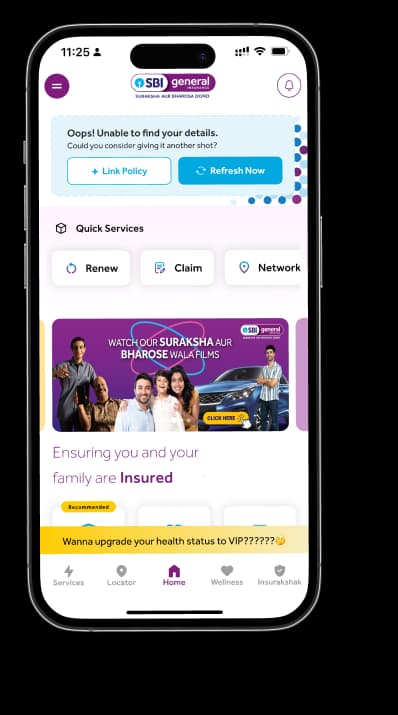
Access and manage all your Insurance Needs in one place, right at your Fingertips.


4/5*
Access and manage all your Insurance Needs in one place, right at your Fingertips.


Vision
Our vision is to become the most trusted general insurer for a transforming India.
Mission
Our mission is to provide simple and innovative general insurance solutions, be responsive to our customers' needs and build a sustainable business for the future.
We're socially active!